
May an algorithm determine what employees or platform workers earn?
AI increasingly influences decisions about remuneration, appraisals and careers. But may an algorithm determine what employees or platform workers earn? Learn which obligations follow from the GDPR, employment-law standards and European AI legislation, and why transparency, human oversight and due care are essential.
Software and AI create new opportunities, but also new liability risks
New EU product liability rules expressly classify software and AI as products. Companies developing software, using AI or selling digital products should review their contracts, processes and insurance in good time to limit liability risks from December 2026.
Cybersecurity becomes a board-level responsibility
Under the new Cybersecurity Act, cybersecurity is no longer only an IT issue but also a board-level responsibility. Entrepreneurs must understand cyber risks, take appropriate security measures and define responsibilities in the event of a cyber incident. This article explains what the new cyber legislation means for governance, liability and cyber resilience within businesses.
A different perspective on finance: what India can teach us
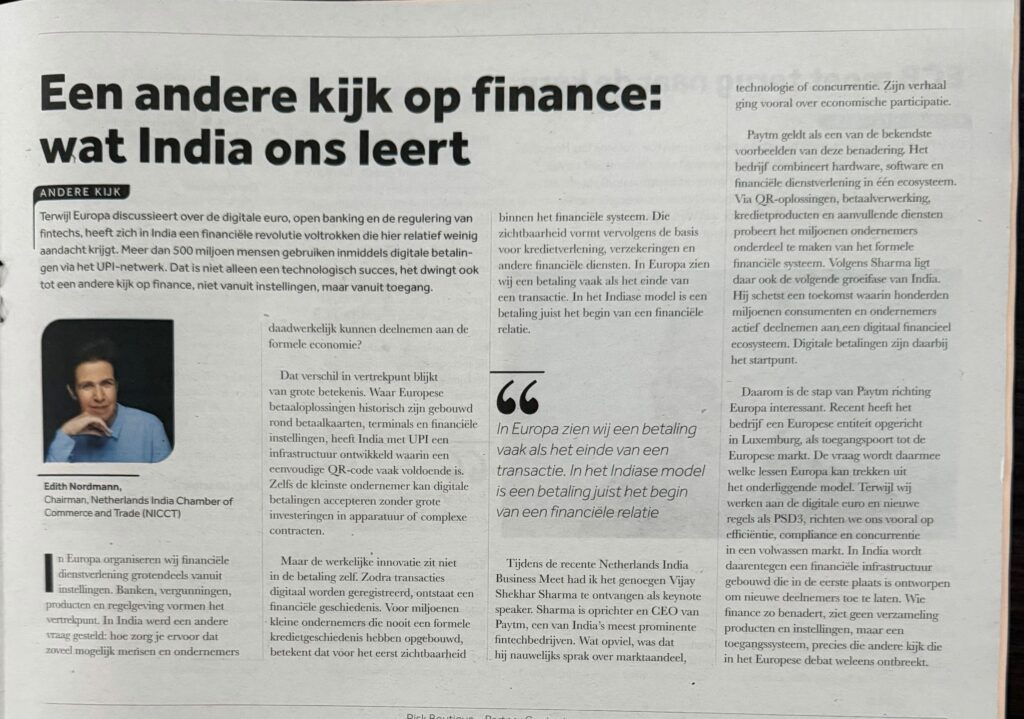
In her article of 19 June 2026 in Het Financieele Dagblad, Edith Nordmann reflects on what Europe can learn from India’s digital financial infrastructure and the way in which it broadens access to finance.
Why entrepreneurs will soon face more questions about their company, UBOs and transactions
Under the AMLR, entrepreneurs will face questions about UBOs, KYC and transactions more quickly. Read how to get your file in order and avoid problems with banks, civil-law notaries and other gatekeepers.
Can You Demand Cash From Your Bank? Amsterdam Court Says No

Can customers always access their money? A recent court ruling shows banks may terminate accounts due to compliance risks. Learn about the right to a basic payment account, AML obligations, and the lack of protection for businesses.
New European Anti-Money Laundering rules will have major impact in the Netherlands

New European anti-money laundering regulations tighten internal obligations and governance:
In addition to a broader scope, the requirements themselves are becoming more stringent. The AMLR mandates that institutions must have a comprehensive and up-to-date AML/CFT compliance framework in place, including documented internal procedures, risk assessments, and control mechanisms.
Can a bank terminate your account without reason?

A foundation that used donor funds for a personal payment led to suspicion from the bank. The judge ruled that the bank was entitled to terminate the account because the foundation did not sufficiently cooperate with the mandatory client investigation and the money flows were unclear. This highlights the importance of transparency, cooperation with the bank, and the proper use of business accounts.
Is the bank liable for fraud? Court: ING must disclose fraud signals

ING was required by the court to clarify what was known within the bank about fraud, such as reports or suspicious transactions. Banks are not only responsible for their own customers, but also for third parties who suffer damage due to fraud by customers. If a bank is aware of abuse, it must intervene. A mere suspicion is not enough; there must be actual knowledge. Victims often struggle to prove this, but the court ruled that they must be given the opportunity to support their case.
AML – How to Effectively Implement Transaction Monitoring?

A financial institution should actively monitor its customers’ payment traffic through transaction monitoring with the aim of identifying unusual activity (including unusually large transactions, transactions to/from high-risk countries, or deviations from a customer’s expected payment behaviour etc.). But transaction monitoring is also essential for lenders, factoring companies and crowdfunding platforms, where payments are usually made via bank transfers or direct debits, to comply with Wwft rules. Read more about this in our latest article.